
How Unit Price Changes for Bulk Insulated Water Bottles Across Quantity Tiers at Cupworlds
In the world of promotional products, corporate gifting, and event merchandise, bulk - ordered insulated water bottles have become a staple. Whether you’re outfitting a team with branded hydration gear or preparing for a large - scale event, understanding how unit price fluctuates with order quantity is key to maximizing value. At Cupworlds, the pricing structure for insulated water bottles follows a clear “quantity - based discount” model—and here’s how it works.
1. The Basics of Quantity - Tiered Pricing at Cupworlds
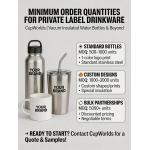
Cupworlds’ insulated water bottle offerings are designed to accommodate both small - scale buyers (like startups or small events) and large - volume purchasers (such as corporations or nationwide campaigns). The unit price of these durable, customizable bottles decreases as order quantity increases, driven by the principles of economies of scale. Let’s break down the typical quantity tiers (and their impact on cost) you’ll encounter:
- Entry - Level Tier (e.g., 1–50 units): For smaller orders, the unit price tends to be the highest. This is because fixed costs (like setup for customization, material sourcing for small batches, and administrative overhead) are spread across fewer units. For example, a premium insulated water bottle might cost $20 per unit in this range.
- Mid - Volume Tier (e.g., 51–200 units): As you cross the 50 - unit threshold, you’ll notice a noticeable drop in unit price. Let’s say the same bottle drops to $18 per unit here. Why? Larger batches allow for more efficient production (e.g., reduced machine setup time, bulk material purchasing) and better cost - sharing for logistics (like shipping a larger box at a lower per - unit rate).
- High - Volume Tier (e.g., 201+ units): For orders exceeding 200 units, the discount deepens further. In this tier, the unit price could fall to $15 or lower. At this scale, manufacturers like Cupworlds benefit from massive production efficiencies, and they pass some of those savings to buyers. Plus, large orders often represent repeat business or high - value clients, so pricing is optimized to attract enterprise - level customers.
2. What Drives These Price Reductions Across Tiers?
Several factors contribute to the decreasing unit price as order quantity rises:
- Production Efficiency: Manufacturing insulated water bottles involves steps like molding, insulation assembly, and customization (e.g., logo printing). For small batches, each unit absorbs more of the “fixed” costs of setup (e.g., calibrating a printer for a logo, preparing molds). With larger orders, these setup costs are spread across hundreds or thousands of units, reducing the per - unit burden.
- Material & Supply Chain Savings: Bulk orders allow Cupworlds to negotiate better rates with suppliers for raw materials (like stainless steel, plastic, or insulation foam). A larger order of 500 bottles means purchasing resin or metal in bulk, which often comes with volume - based discounts from vendors.
- Operational Cost Sharing: Shipping 500 bottles in one pallet is far more cost - effective (per unit) than shipping 500 individual packages. Warehousing, fulfillment, and logistics costs are also easier to spread across a high - volume order, lowering the overall cost per bottle.
- Strategic Marketing: Cupworlds incentivizes larger orders to build long - term relationships with businesses and organizations. By offering aggressive pricing for high - volume tiers, they encourage customers to commit to bigger purchases (and potentially return for future orders).
3. Real - World Example: Pricing Tiers for a Custom Insulated Bottle
To illustrate, let’s use a hypothetical (but realistic) pricing structure for a 17 - oz stainless steel insulated water bottle at Cupworlds:
| Order Quantity | Unit Price (USD) | Total Cost for Tier |
|---|---|---|
| 1–50 | $20.00 | $20–$1,000 |
| 51–200 | $18.00 | $918–$3,600 |
| 201–500 | $15.00 | $3,015–$7,500 |
| 501+ | $13.50 | $6,763.50+ |
In this example, moving from the 1–50 tier to 51–200 reduces the unit price by 10%, while jumping to 201+ cuts it by 25% (vs. the lowest - volume tier). For a business needing 200 bottles, buying 201 to hit the next tier could save $600 (200 × $18 = $3,600 vs. 201 × $15 = $3,015—plus extra inventory for future needs).
4. Tips for Maximizing Savings on Bulk Orders
To leverage Cupworlds’ quantity - tiered pricing:
- Analyze Your Total Need: If you need 45 bottles, consider whether buying 51 (to hit the next tier) makes sense. The $18 per unit for 51 might be cheaper than 45 at $20 (45 × $20 = $900 vs. 51 × $18 = $918—close, but if you can use the extra 6, it’s worth it).
- Plan for the Long Term: If your organization regularly needs branded bottles (e.g., new hires, annual events), stock up in the highest tier your budget allows. The per - unit savings add up over time.
- Collaborate with Partners: For smaller teams or events, pool orders with other departments, local businesses, or organizations to reach a higher quantity tier.
- Customize Strategically: Some customization options (like full - color printing) might have their own volume tiers—ensure these align with your quantity goals to avoid unexpected costs.
Conclusion
At Cupworlds, the unit price of insulated water bottles follows a clear pattern: the more you order, the less you pay per bottle. By understanding quantity tiers, the economics behind them, and your own purchasing needs, you can transform a bulk order into a cost - effective investment in branding, employee wellness, or event success. Next time you’re browsing Cupworlds for insulated water bottles, use the quantity - tiered pricing to your advantage!

 English
 German
 French
 Russian
 Spanish
 Japanese
 Korean
 Portuguese
 Ukrainian
 Arabic
 Italian

